
White, Stone and Wind: The Traditional Architecture of Formentera
There is a very specific moment when you arrive in Formentera for the first time, when everything you have seen before—the photographs, the videos, the stories told by friends—suddenly stops being enough.
It happens when you find yourself standing in front of a white house that seems to have emerged directly from the rock itself, with its thick walls, small windows, and limewashed surfaces shining beneath the July sun.
It looks unlike anything you have ever seen.
And yet, somehow, it feels as though you have always known it.
Traditional Balearic architecture is not a style invented by architects.
It is a response.
A response to heat, wind, limestone, water scarcity, and isolation.
For centuries, the people of Formentera built their homes using whatever they had available. And what they had was the land beneath their feet, their hands, and common sense.
The result is something remarkably rare: an aesthetic born from necessity that ultimately becomes pure beauty.
To understand this architecture is to understand the island itself.
And to understand the island is to understand why certain homes here are valued the way they are, and why the people who live in them never stop wanting to return.
The Finca Payesa: The Farmer’s House That Invented Luxury
Everything begins with the finca payesa.
This was the traditional home of the island farmer—the pagès in Catalan—who lived on Formentera long before the arrival of tourists, designers, and architecture magazines.
It was functional, essential, and built to last.
Over the decades, it became one of the most admired and widely copied architectural models in the Mediterranean.
The original structure was simple: a central building with only a few rooms, walls built from local limestone and coated with white limewash, a flat or slightly sloped roof, and an entrance door traditionally facing the rising sun to capture warmth in the early morning.
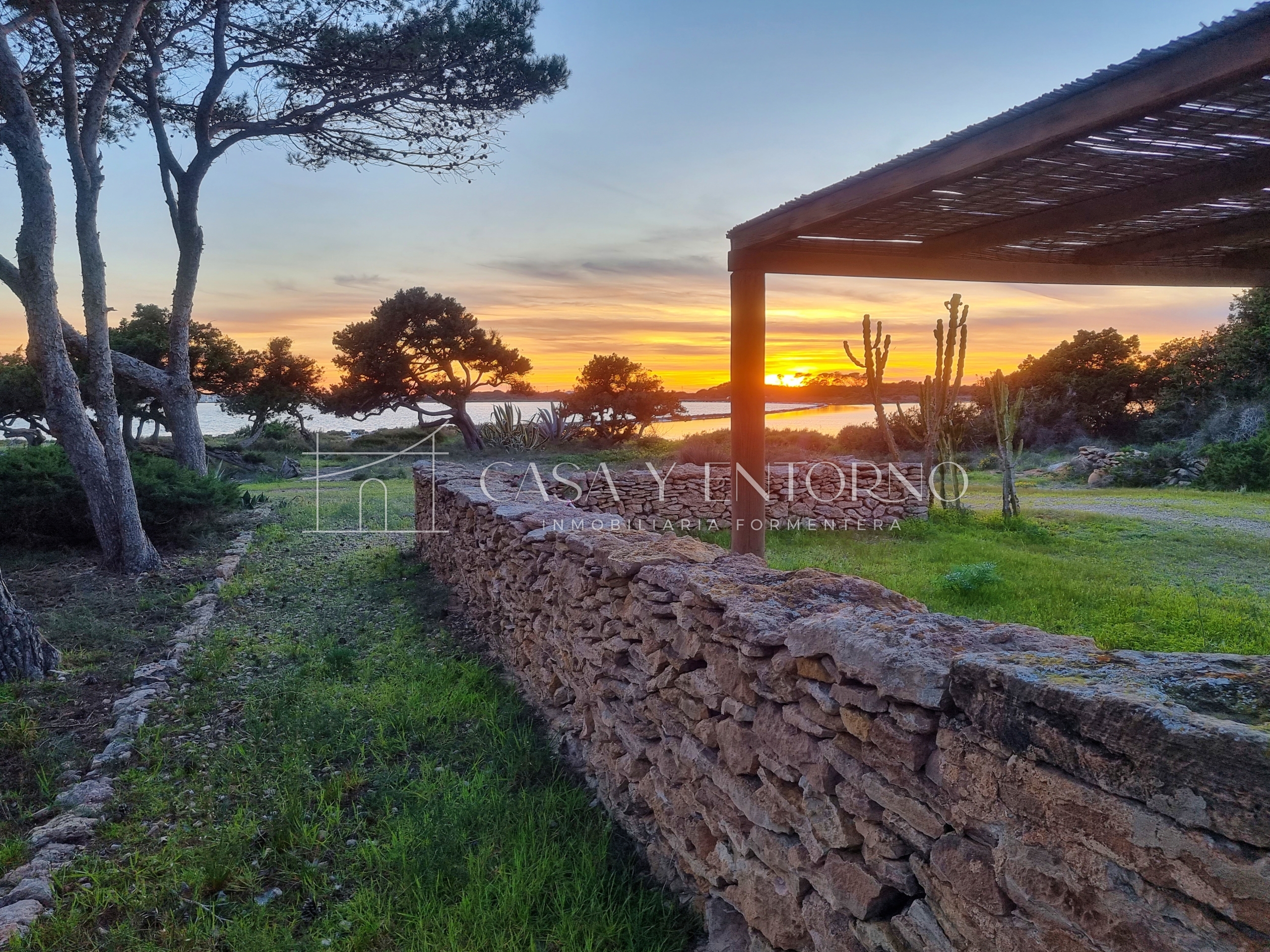
Surrounding the house were the characteristic dry-stone walls known as secans, which divided farmland and protected crops and livestock.
This was an architecture that did not attempt to dominate the landscape.
It sought to become part of it.
What is most striking when viewed through modern eyes is how closely this logic anticipated everything contemporary design strives to achieve: minimalism, natural materials, environmental integration, and respect for place.
The humble payesa house was never designed to be fashionable.
It was authentic.
And that is precisely why it became fashionable.
White: More Than Just a Colour
If there is one defining symbol of Formentera’s architecture, it is white.
The island’s white houses are not an aesthetic choice.
They are a climatic one.
White limewash reflects sunlight and heat, lowering indoor temperatures by several degrees compared to the outside environment.
Before air conditioning existed, this was the only practical way to make homes comfortable during the island’s scorching summers.
Long before modern designers embraced minimalism, it was simply common sense.
Limewash also served antibacterial and waterproofing purposes.
Every year before summer, it was applied as part of a ritual preparation for the season ahead.
The women of the island traditionally coated the walls using brushes made from raffia or dwarf palm fibres, restoring each home’s brilliant brightness.
This annual gesture—which today we might simply call maintenance, although it carried an almost ceremonial significance—can still be seen in some of Formentera’s oldest fincas.
Thick Walls and Small Windows: The Physics of Cool Living
The thick walls and small windows were not architectural choices in the modern sense of the term.
They were applied physics.
Stone walls, often between sixty and eighty centimetres thick, acted as thermal mass, absorbing heat throughout the day and slowly releasing it at night when outdoor temperatures dropped.
The house warmed up slowly and cooled down slowly, maintaining a remarkably stable indoor climate.
Small windows, frequently positioned on the north side or protected by solid wooden shutters, reduced direct solar exposure.
Roofs were supported by olive or fig wood beams—the most abundant timber species available on the island—and covered with dried seaweed and earth, creating an additional layer of natural insulation.
The result was a home that remained cool during summer and relatively warm during winter, without heating systems or air conditioning.
No technology.
Just intelligence.
The very same intelligence that many contemporary architects are rediscovering today through the principles of bioclimatic and sustainable architecture.
The Porxada, the Cistern and the Well: Details That Tell the Story of Island Life
Traditional homes in Formentera were far more than four walls and a roof.
Every element served a precise purpose, designed to ensure survival on an island where fresh water was scarce and modern infrastructure did not exist.
The Porxada
The porxada was the covered porch that defined the entrance to the house.
It served as a transitional space between indoors and outdoors.
It provided shelter from the sun during the hottest hours of the day, a shaded place to work, and storage for agricultural tools.
Today, it has become the preferred setting for outdoor breakfasts, long lunches, and evenings overlooking the sea.
Its function has changed.
Its importance has not.
The Cistern and the Well
Water was gold in Formentera.
Every house had a cistern—often underground and accessible only through a small opening in the floor—where rainwater collected from the roof was stored.
The cistern was the true heart of the home.
It determined whether a family could survive the long, dry summer months.
Many of the island’s oldest fincas still preserve their original cisterns, no longer necessary for everyday life but carefully maintained as part of Formentera’s cultural heritage.
The Forn
The outdoor wood-fired oven—known locally as the forn—was present in almost every property.
Bread was baked once a week, and the remaining heat was used to dry figs, preserve herbs, and roast vegetables.
The oven’s external location also prevented excess heat from entering the house.
Once again, this was not romanticism.
It was practicality.
How to Recognise an Authentic Traditional House in Formentera
Not every white house in Formentera is a genuine traditional home.
The years of tourism expansion produced countless imitations—some successful, others less so.
However, there are still several details that distinguish an authentic finca from a modern reproduction.
The Walls Have Irregularities
Hand-built homes do not have perfectly straight corners or completely uniform surfaces.
It is precisely this imperfection that gives them their beauty and character.
The Stone Remains Visible
In many traditional houses, the limewash layer is thin enough to reveal the texture of the limestone beneath.
Modern renovations often conceal these details completely.
The Floors Are Made of Terracotta or Handmade Ceramic
Traditional terracotta tiles, handcrafted ceramics, and colourful hydraulic tiles are characteristic features.
Not porcelain stoneware or industrial flooring.
The Ceiling Beams Are Exposed
Dark, irregular olive wood beams remain one of the most distinctive elements of traditional interiors in Formentera.
Living Tradition in the Modern World
There is a fascinating paradox within Formentera’s architecture:
The older a building is, the more contemporary it feels.
Traditional fincas align almost perfectly with the principles of modern sustainable architecture.
They consume very little energy.
They use local, natural materials.
They integrate seamlessly into the landscape.
And they adapt intelligently to the climate.
If someone were to build them from scratch today, they would likely be described as cutting-edge.
This explains why many of the most sophisticated buyers in Formentera’s real estate market are not searching for villas with infinity pools and floor-to-ceiling glass walls.
Instead, they seek traditional fincas that can be restored with care and respect.
Preserving the olive wood beams.
Retaining the cistern.
Protecting the porxada.
Because they understand that what they have found is not a ruin waiting to be rebuilt.
It is knowledge worth preserving.
Formentera teaches many lessons to those who know how to listen.
Its architecture may be the quietest and most profound of them all:
That beauty which endures over time is not born from excess, but from an intelligent and respectful response to the place where we live.
A lesson that, while standing before a white house beneath the July sun, feels as though you have always known it.
Are You Looking for an Authentic Finca or a Character-Filled Villa in Formentera?
Explore our exclusive portfolio of properties and discover homes that combine heritage, authenticity, Mediterranean charm, and exceptional quality of life.
Traditional fincas, luxury villas, charming island homes, and exclusive real estate opportunities in Formentera: